 IU8QTM
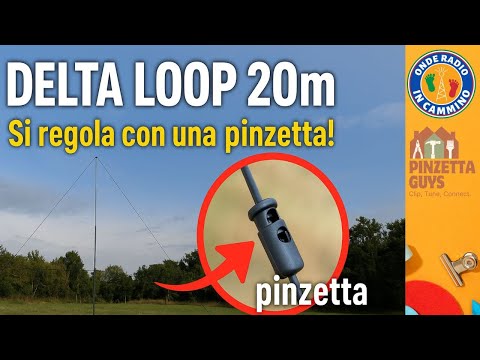
Staying true to the spirit of homebrewing and field experimentation, I built a new version of my Delta Loop antenna, this time designed for the 20 metre band. The idea is the same as the 10/11 metre version: a lightweight, adjustable design, easy to set up even in portable operation, and built from cheap, easy-to-find materials.
Materials used
- Single-core copper house wiring, 0.75 mm²
- RG59 coaxial cable for the matching stub
- Cord-through clothes pegs (from travel clothesline cords) to adjust the wire length
- Some tent cord and carabiners for mounting
- 3D-printed supports, or a 6-metre telescopic fishing pole
Antenna geometry
The Delta Loop has a triangular shape and is installed point-up. The sides of the triangle were calculated to resonate around 14 MHz, but the interesting part of this design is that, thanks to the pegs, the effective length can be quickly adjusted to optimise SWR and impedance depending on the setup and surrounding environment.
Feed system
The antenna is fed through an RG59 stub (about 380 cm long), connected to the side of the triangle at a precise distance from the base, around 80 cm. This system gives a good impedance match without external baluns or transformers. The feed point connects directly to the stub, which acts as the matching element, keeping the impedance close to 50 Ohm across most of the band.
Advantages
- Simple to build, even for beginners
- Easy to adjust with the pegs: just move them to change the loop length
- Great transmit performance thanks to the closed loop shape and antenna efficiency
- Works well even at low height above ground (ideal for portable operation)
- No tuner needed, if well matched
Where it can be used
Perfect for portable operation, SOTA, POTA, and temporary or semi-permanent setups in a campsite, balcony, or garden.
 Watch the video
How it performs in the field, from theory to real tuning